
🔹 What Is a Learner?
Merriam-Webster defines learning as “to gain knowledge or understanding of or skill in by study, instruction, or experience.”
For me, learning goes beyond books and practice—it’s a natural, internal process. It’s the deep acquisition and meaningful application of new knowledge or skills, shaped by both context and connection.
Learning happens when the why is clear.
🔹 The Lindsey Philosophy of Learning
Why do we choose to learn anything?
Because we’re wired to ask, “Why?”
Why do we believe what we believe?
Why does this work the way it does?
Why is the sky blue and not black?
These are simple questions—but their pursuit has built entire universities, books, TED Talks, and YouTube rabbit holes.
Learning isn’t just absorbing. It’s sharing, reflecting, and connecting. It’s the moment when curiosity collides with clarity, and you can’t help but pass it on.
✊🏾 The Origin of REACH: My Learning Framework
In the fall of 2017, after Hurricane Harvey shook our city and our schools, I was challenged—like many educators—to reconnect with my students and restore a sense of purpose.
From that season of adversity came a philosophy that still drives everything I do:
REACH – Respect, Encourage, Aspire, Create, Honesty
At first, it was a motivational tool for my classroom. But with time and reflection, I realized:
REACH wasn’t just for students.
It reflected me—how I learn, how I teach, how I live.
📚 The REACH Learning Philosophy
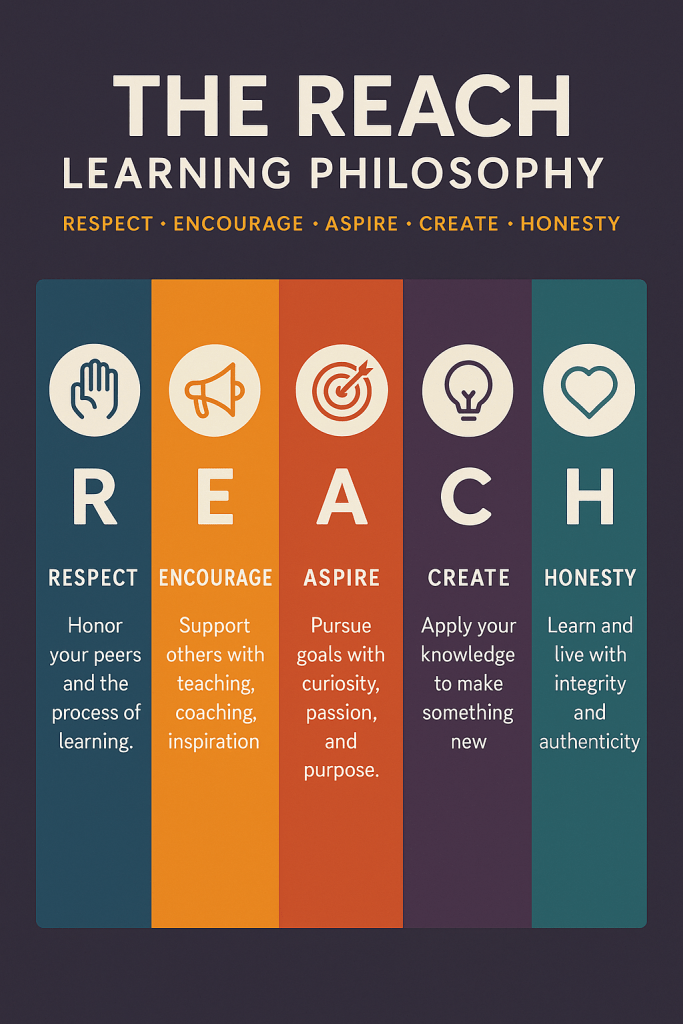
R – Respect
Respect your peers. Respect your journey. And most importantly, respect the process of learning—even when it’s messy, painful, or unclear. Growth often looks like failure in the beginning.
E – Encourage
Encouragement fuels momentum. As learners, we thrive when supported—by mentors, coaches, friends, or even small wins. Encouragement turns curiosity into action.
A – Aspire
Aspiration gives learning its direction. When a subject clicks, learners go all in—watching videos, asking questions, chasing understanding. Passion turns interest into purpose.
C – Create
Learning isn’t just about taking in information—it’s about applying it to make something new. I connect ideas across fields to reshape the way I see the world and show others how to do the same.
H – Honesty
Without integrity, learning loses its purpose. I pursue knowledge to grow honestly, not just to be impressive. Honesty grounds education in humility and human connection.
🧠 Teaching vs. Learning Philosophy
Right now, my teaching and learning philosophies walk hand-in-hand.
Learning is a universal experience—but the how is personal.
My philosophy is always evolving, just like I am. And until the journey is complete, I’ll keep learning, unlearning, and rebuilding as both an educator and a man.
📖 Learning Theories I Align With
Though all three major theories (Behaviorism, Cognitivism, Constructivism) shape how we learn, I find myself most aligned with Constructivism.
I learn best when I connect new information to past experience. It’s like building a puzzle where each new piece makes the picture clearer. That process reminds me daily that I haven’t capped my potential—and that’s what learning is truly about.
🧱 Final Thoughts
I was raised by a powerful educator—Dr. Jacqueline Lindsey—a pioneer in math and cheer in North Forest ISD.
I saw firsthand the impact one teacher can make.
Now, I carry her legacy by helping others REACH for something greater—through education, mindset, and meaning.
I don’t just teach. I don’t just learn.
I transform, and I help others do the same.
📚 References
(Retained for academic use, cleaned and standardized formatting)
- Dweck, C. S. (2006). Mindset: The New Psychology of Success. Random House.
- Harapnuik, D. (n.d.). Educational Development Philosophy. Website
- Horn, M. B., & Staker, H. (2015). Blended: Using Disruptive Innovation to Improve Schools. Jossey-Bass.
- Merriam-Webster. (n.d.). Learner. Retrieved from https://www.merriam-webster.com/dictionary/learner
- Sinek, S. (2013). Start with Why: How Great Leaders Inspire Everyone to Take Action. Portfolio/Penguin.
- Sinek, S. (2013, September 29). TED Talk: Start With Why. YouTube
- What is PBL? (n.d.). PBLWorks. Retrieved from https://www.pblworks.org/what-is-pbl
 Where Dreams & Learning Meet!